

BIM 5D
Updating workflows for the improvement of project quality is one of Civile‘s internal goals. Therefore, we have made improvements to our workflow for 5D BIM Usage (extraction of measurements from the BIM model). One of these improvements is to take this Usage one step further and include the budget in the BIM model, so that external agents, who do not necessarily understand the structure of a budget, can easily check how much a unit of work costs or what items make up the project.
Budget and geometry are integrated into an IFC model. All this using open and editable formats and with programs developed internally in the Python programming language.

Illustration 1 –> Budget included in the BIM Model
What is BIM 5D?
It is the application of the BIM methodology for the “semi-automatic” extraction of budget measurements from the BIM model of the project. The intrinsic geometric information in the BIM models is used, since, thanks to the effort of our colleagues, these models have a high accuracy. This effort is taken advantage of, and this geometric information is extracted to generate the measurements of certain budget items. Specifically, it is used for a minimum of 60% of the total cost of the budget.
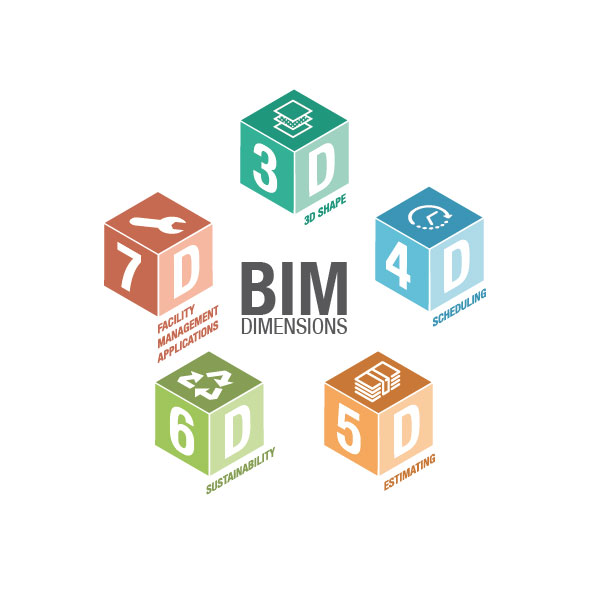
Illustration 2 –> 5 Dimensions of the BIM Model
The advantages of using BIM models to extract measurements, according to the “Guide to Using Models for Cost Management” from the now defunct es. BIM platform https://cbim.mitma.es/biblioteca), are as follows:
- Accurate, model-consistent and reliable measurements at all stages of the project and throughout the life of the project
- Traceable and transparent measurements allowing geometric justification.
- Automatic update of these measurements once the models are modified (with the application of Measurement Rules).
- Data transmission (traceable and transparent) from the design, bidding, construction, operation, etc. stage.
- Improvement of the certified elements, being able to trace the traceability of measurements and certifications to eliminate any possible doubt or discussion about the validity of the information in the certifications.
- Improved communication and collaboration among team members
- Allows to know in a simpler way the budget of different design alternatives.
- Anticipation, with a high degree of precision, of the economic cost of modifications and variations to the project or work.
- Avoids contradictory prices within the budget
- Increases the quality of the project by giving greater coherence to the different project documents: plans, specifications, specifications and budget (since all these documents can come from the same BIM model).
In Civile we wanted the model to be used not only for the extraction of geometric data, but also so that you can really check the cost of a wearing course or a reinforced column of the project without having to go to the PDF listing of the budget.
How did we do it?
We have taken advantage of the features of Open BIM and open formats. We know the data schema of the IFC standard and we know the information containers of the FIEBDC format (Standard Interchange Format for Construction Databases). Therefore, we have to extract the information from certain budget containers and include it in the correct place in the IFC schema.
The first thing we have done is to extract the information of items, measurements, codes, etc. from the budget. This information is not useful as it is in the budget. It has to be edited to organize it in such a way that it is easier to enter it in the IFC model. The information of a budget item should only be entered in the object that represents the unit of work that values that item. That is, the information of a line item that values the m3 of “Precast concrete column…” can only be included in the objects that are precast concrete columns.
Once we have classified the budgetary information, we do the same with the (non-geometric) information of the IFC model.

Illustration 3 –> IFC file
Once we have all the project information classified, we enrich the IFC file with all the budget information. All this process is automatic because we have created a program that automates all these tasks.


Illustration 4 –> Program
Therefore, thanks to the advantages of the BIM methodology and the features of Open BIM we have been able to improve our product and make the projects we work on have complete models in terms of information. Open BIM increases the quality of the projects and this is an example of it.
Don’t miss the rest of CIVILE’s blog entries!
Written by:
Ángel Díaz Murillo
Civil Engineer
BIM Development Area