

The term “rehabilitation” has always been very close to all of us who have developed professionally in the construction sector, and especially in the disciplines of architecture and urban planning. In fact, it has been, is and should continue to be a practice that is far enough away from certain trends that have accompanied us in recent decades and in which it seemed that nothing was valid and therefore had to destroy to redo.
In the two decades of the 21st century, the expression “energy rehabilitation” has become part of our everyday vocabulary and, specifically in Spain, under the protection of an increasingly restrictive and environmentally responsible Technical Building Code, in addition to other even more demanding sustainable certification standards and seals.
All this, backed up by countless aid schemes from an incessant trickle of European funds, means that the architect on duty is faced on more than one occasion with an intervention in which rehabilitating a building from the energy point of view is almost as important as the formal, functional, constructive, structural or urban aspects.
Playing a little with the RAE, rehabilitate means to enable again or restore someone or something to its former state. But if we are orthodox, when we face an energy rehabilitation action, it is generally not about returning to a previous point, because then we would fall back into the same mistakes. It is about replacing, improving and enhancing the energy weaknesses of buildings, relying on all the technical possibilities offered by the market today, both in passive solutions and much more efficient active systems.
According to the IDAE, Spain has 25 million homes and one of the largest energy obsolete building stock. It is estimated that there are some 2,000,000 homes in a poor state of repair.
In terms of energy efficiency, the deficit is very significant, since 90% of the buildings predate the application of the Technical Building Code and 60% of Spanish homes were built without any energy efficiency regulations (they predate the application of the NBE-CT 79 standard).
This means that by 2020, buildings and the construction sector will account for 38% of global CO2 emissions.
In this sense, the support and involvement of the Administration in this type of interventions is necessary. We firmly believe that the professional sectors are increasingly aware of a more efficient and sustainable professional practice, but there is still a long way to go in terms of the role of the citizen, who sees how the amortization of certain actions that involve energy savings occurs in the long term.
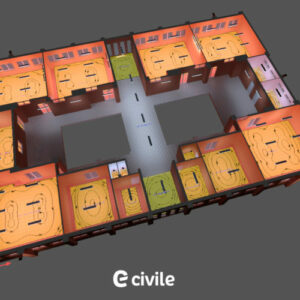
In this context, from Civile we have had the opportunity to develop several projects in which we have undertaken a series of actions that involved significant savings in energy consumption of several buildings, generally built several decades ago, and in which we have intervened in both passive systems, with improvements in the building envelope acting on facades and exterior carpentry, and active systems in which there is a significant decrease in direct consumption of primary energy and that leads to lower spending on electricity consumption, such as replacing the lighting or HVAC installation by other much more efficient ones.
In conclusion, building and rebuilding with a more sustainable mentality is a role that all of us involved in the construction sector must play, not only to stimulate an economy that has a development potential that has no end in sight, but also to carry out concrete actions in our daily lives that provide economic and comfort benefits for users and, above all, environmental benefits for our planet.